Prodigal Insights
The Cross & the Prodigal
It was the fall of 1989 — the worst fall of my life.
I dropped into a warm bath.
Clothes still on.
Water still running.
I had grabbed a book from my dad’s pastoral library, The Cross & the Prodigal, by Dr. Kenneth Bailey.
I read it cover to cover.
Then I sprang from that tub.
Something had shifted. Something had clicked.
That fall no longer had the last word. Ever since, I have been trying to wrap words around that moment. That journey has kept me warm. Water still running.
Over time, I read all of Bailey’s books, wrote him, and met with him in person a number of times. To my surprise, Bailey’s understanding of Jesus’ culture and the original languages — Hebrew, Greek, and Aramaic — made Bible verses smile, simmer, scream.
Bailey loved systematic theology. I was a technical systems architect. Different disciplines, same instinct: trace the structure, follow the meaning, and search beneath the surface for what others missed. My questions kept refilling. His letters kept flowing.
The Bulletproof Prodigal
When Jesus told the prodigal son parable, it wasn’t a campfire story. It was a “use case.”
Two words I’d hear a dozen times a day in my work as a systems architect. A use case is a story. It’s designed to illuminate your idea. Examine it from every angle. Stress-test it. Determine whether it’s bulletproof.
The Pharisees had a fundamental question for Jesus: “Why do you eat with sinners?”
So Jesus gave them a use case that couldn’t be broken.
The Enemy in the Family
Characters
- Younger son = sinners (and tax collectors)
- Older son = Pharisees (and scribes)
- Father = God / Jesus
It was a masterstroke, to my mind, that Jesus cast both Pharisees and sinners in one family.
The Pharisees had built their lives around separation — keeping themselves clean from sinners, refusing to eat with them, treating sin as a defilement God had commanded them to flee. Their holiness code wasn’t cruelty for its own sake. It was devotion. They worked full-time jobs, then studied Torah late into the night, following the rules to the letter.
They worked hard to avoid sin. Sinners played in it.
Putting both groups in the same family — the same house? Brilliant.
Jesus’ casting created a perfect use case.
What Do You Desire?
What does the character want? is one of the most asked questions by actors and directors. It’s asked at every level of a story — the whole, the scene, the beat (the smallest unit of story).
Jesus, as the director of this parable, casts the Father as his protagonist — the Father who represents both God and Jesus. And we know exactly what this Father wants, because the Pharisees had pressed this same question in Matthew 9:10–13: Why do you eat with tax collectors and sinners? Jesus answered by quoting what God wants in the Old Testament — Hosea 6:6:
“I desire hesed, not sacrifice.”
The Hebrew word Hesed (חֶסֶד) is covenant love — love that comes down before it goes around. The stronger one holds the umbrella and draws the beloved under it. He gives first, beyond what is owed, before anything is returned. The answering love is real, but it is the fruit his love creates — not the price of admission. Not love earned between equals. Love that comes down, and holds.
Hebrew, not Greek
And here is the strange thing about that word. When hesed crosses into Greek — the language of the New Testament — it finds no twin waiting.
Greek is a precise tongue. It had a word for mercy — eleos. A word for righteousness — dikaiosynē. A word for kindness in action — eleēmosynē. A word for favor freely given — charis.
Four windows.
Hesed is the room behind all four.
For people to comprehend, it has to be shown. As Jesus did in the prodigal son parable.
Hesed is Love that holds
Dead End
Stated desires are one thing. True desires are revealed by actions.
From my point of view, Jesus wanted to show the Pharisees that the actions of their laws didn’t create hesed.
The Pharisees thought like lawyers. Facts first, emotions later. I knew the instinct, because it was mine. There could be no trust unless the use case was bulletproof. So Jesus told them the prodigal son parable.
By the law’s measure, the prodigal was worthless. The Old Testament Hebrew in Deuteronomy 21 weighed his worth: the root zalal (זָלַל) means “to be light, of no weight” — worthless.1 The stubborn and rebellious son of Deuteronomy 21:18–21. Verdict: stone prodigals at the gate. (See homepage for more on Deuteronomy 21)
Jesus included a famine in the parable. Two things happened:
It created a dead end. Cut off at home and starving abroad, the prodigal had no good options — a legal death at his village or a slow death in the far country.
It uncovered his motive. The prodigal wanted bread. Not restoration with his Father. He’s starving. The only reason the prodigal thought of home was his remembering that “even the hired hands have more than enough bread.”
One Provision
However, there was one who could intervene — the Father.
What did Father do when he saw the prodigal “still far off”?
He ran. No. He sprinted — to his son, and repeatedly kissed him, before either said a word. Bailey writes that the word used in the Greek, dramon, is the technical term used for a footrace in a stadium.2
There would be no starving. No stoning.
Jesus showed the Pharisees the verb of hesed. The chain-reaction.
- The heartbeat. The love running through the whole body before a single limb moves. The Father loved his son even before he saw him, before he turned. This is hesed.
- The gut. The life lurching. “While he was still a long way off,” something heaved inside the Father — not a calm attribute, a spasm. Bailey says that it’s shameful for a Middle-Eastern man to run; women run, dignified men walk; the Father would have to hoist his robe, like a woman lifts her dress.3 This is racham (Hebrew) / splanchnizomai (Greek).
- The eyes. The life re-seeing. The son expected there’d be a fist. But he looked up and saw the Father sprinting with joy. The old picture dissolved — the angry master he’d rehearsed a speech for was never there. New eyes, new Father. This is metanoia (Greek).
- The feet. The life turning. The Father’s feet sprinted out; then the son’s whole self turned home. The Father names it: “this son of mine was dead, and is alive again” (Luke 15:24). This is shub (Hebrew) / epistrephō (Greek).
The Pharisees had reversed the sequence. They started with shub — repentance first: the sinner must first “turn his feet” back to God. Earn it back. Then his Father could respond. In the far country, the younger prepared a rehearsed confession that read, “I am not now worthy…Make me a hired hand…” (Luke 15:19) — a plan to work to restore himself by his own efforts.
But Jesus wanted to impress upon the Pharisees that it’s the seeker — the Father — who searches, carries, and restores his beloved.
Jesus told three interrelated parables: the lost sheep, the lost coin, and the lost son. In each — it is the seeker who restores.
Ask yourself:
What did the sheep do to restore itself? What did the coin do to restore itself? What did the son do to restore himself?

Jesus declared, “There will be more joy in heaven over one sinner who repents.” (Luke 15:7). Bailey described Jesus’ definition of repentance as someone who accepts being found.4 Amazingly God/Jesus does it all with joy. Now that’s someone who sees past time.
Now that sounds like a “happy ending” to the parable.
The Ultimate Reversal
But when the parable ends, the older son — the Pharisee — was outside. Angry.
And the younger son — the sinner — was inside. Happy.
So how did the Pharisees respond to this parable? In Luke’s own telling, the grumbling that opened it (Luke 15:2) hardened — into ridicule by the next chapter (Luke 16:14), and by Luke 19:47 the leaders were “seeking to kill him.” Some would plot his execution.
Jesus stepped into the parable.
Here’s a paradox.
The rebellious son went on living. To protect their own sons from Deuteronomy 21, the rabbis built legal fences so high that they finally declared: there never was, and never will be, a stubborn and rebellious son (Sanhedrin 71a). The law’s own guardians recoiled from the sentence. See homepage
The obedient son was executed. Jesus was charged as the rebel against God — accused of being “a glutton and a drunkard,” the very charge-pair of Deuteronomy 21:20 (Luke 7:34).
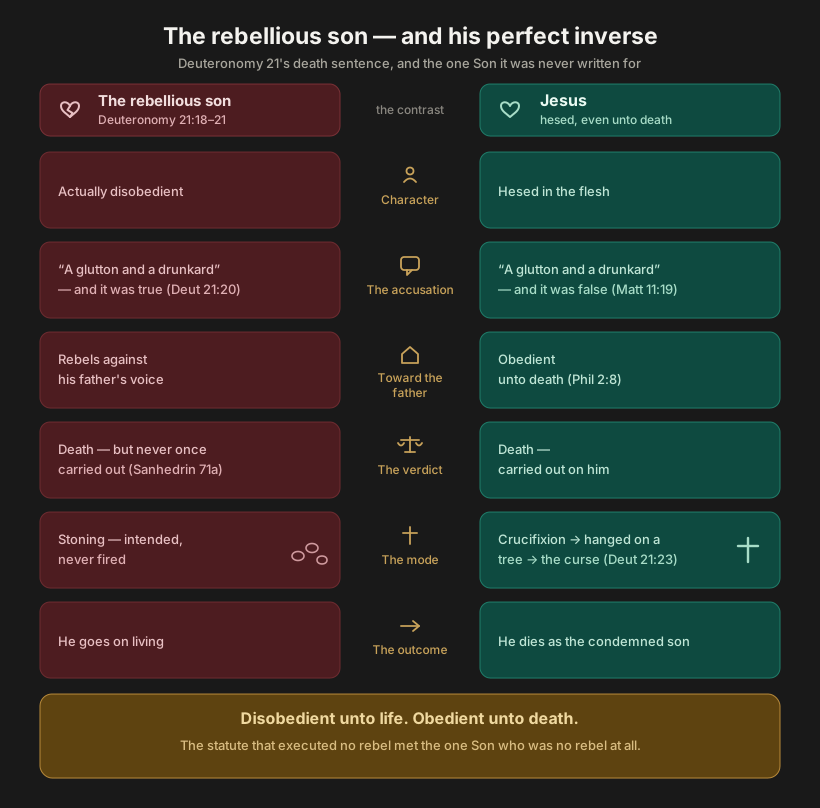
Jesus was executed, in part, because the Pharisees had an incorrect picture of Jesus/God.
Projection Absorption
Over the decades, I’d read and hear, “Jesus absorbed God’s wrath.”
My own truth says that Jesus absorbed our projection — the curse we manufactured and pinned on God, not the Father’s wrath. The Pharisees cast Him as the rebel — the zolel, the worthless prodigal, the exact inverse of who He is — and He let the false verdict land. That’s the projection machine running at full power against its own Maker, and His answer was not a counterstrike — but hesed.
It wasn’t only the Pharisees who saw Jesus wrongly. His own disciples, James and John — after some two years at his side — asked Jesus to call fire down on a Samaritan village for refusing to receive Him. Much like Elijah did in 2 Kings 1:9–12. Jesus turned and rebuked them, “You do not know what manner of spirit you are of; for the Son of Man came not to destroy lives but to save them” (Luke 9:54–56).5
The wrong picture always hunts for someone to curse. Had a prodigal in Deuteronomy 21:18–21 been stoned to death — his corpse would then have been hung on a tree to designate that person as “cursed” by God (Deuteronomy 21:22–23). 1 Peter 2:24: “He bore our sins in his body on the tree.”
From my point of view, the use case was complete. I saw God’s love in a new way. My metanoia. My new picture of God.
But I was left wanting.
Older Son - After Jesus
I felt like the older brother in the parable. Left angry, out in the courtyard. “Not even a goat for me.” Then the parable ends. A broken chord.
I remained in that courtyard for a long time. Then something happened. I cast the Apostle Paul into the role of the older brother. Why? Because Paul described himself as the Pharisee of Pharisees. In the prodigal son parable, Jesus was talking directly to the Pharisees, and Paul would have been a young man — likely in his twenties — when Jesus was crucified at age thirty-three.
For me, Paul was the perfect candidate to play the older brother role. Why? Nobody did more to destroy the Father’s work, Jesus’ work, than Paul. He approved of Stephen’s stoning and ravaged the church, dragging believers to prison. Rather than narrate my thinking, I wrote a rap — “Prodigal God: Arresting Affection” — then used Suno to wrap a beat and vocals around it. In it, I tried to climb into Paul’s skin. To viscerally feel what he may have felt. Listen to “Prodigal God - Arresting Affection”
Damascus Road was Paul’s turning point. His metanoia moment. Jesus sent his enemy Ananias “Brother Saul (Paul)” to show him hesed love (Acts 9:17). Paul’s re-seeing propelled him across the world, reaching his former enemies — the Gentiles. Revealing that God’s hesed is for all. And for me.
Older Son - Before Jesus
One final chord needed resolution. What about Deuteronomy 21 itself? How did it come into existence? Something so far from God’s hesed?
For decades I’d hear this explanation. When Deuteronomy 21 was written, pagan parents held final authority over their children, and some pagan cultures would sacrifice their own children as form of worship. So Deuteronomy 21:18-21 was put in place to protect families. Mothers and fathers were required to bring their prodigal sons before the elders of the village so that there would be level-headed oversight. Resulting in an improvement. As noted, there is no biblical record of a prodigal son ever being convicted and stoned.
This explanation helped — to some degree. But it still seemed like a monstrous command.
Then most recently, in doing additional research for this website, I learned more about the author of Deuteronomy 21 — Moses. As I read Moses’ writings, I was struck by how often he was angry.
Early in his life, Moses struck — in anger — an Egyptian dead then fled for his life. Then, forty years later, just outside the Promised Land, Moses struck — in anger — the rock twice. God wanted Moses to speak to the rock, so the water would flow to his thirsty people. Compounding this, Moses projected his anger onto God — making the people think God saw them as rebels — “Hear now, you rebels” (Numbers 20:10).
The same verb describes both strikes: nakah (נכה), “to strike, to smite” — the Egyptian (Exodus 2:12) and the rock (Numbers 20:11). Forty years on, the same anger still fired. Because of it, God barred Moses from entering the Promised Land. Shortly after, Moses died.
God wanted to show his hesed. Instead, they got an angry Moses — misrepresenting God.
But here’s the amazing part. Roughly 1,400 years later, Moses stood with Jesus on the Mount of Transfiguration. Moses was barred from the Promised Land in life — yet there he stood, with Jesus. Is Jesus awesome or what? Moses’ limited character arc did not keep him from being with Jesus. Whoa. That gives hope to me, my dad, and to anyone stuck outside the Promised Land in this life.
So I asked myself, “Did some of Moses’ anger project itself into Deuteronomy 21?”
I don’t know — but it does seem plausible to me.
Jesus himself said the Law made accommodations. He said Moses permitted divorce “because of the hardness of your hearts” — but “from the beginning it was not so” (Matthew 19:8). It was not the original design.
Here’s how I want to end my story.
When God spoke to Moses about striking the rock twice in anger, God said nothing about his anger. He gave one reason for all of it: Moses did not trust Him (Numbers 20:12). Which circles back to my core question. Can I trust God — and Jesus?
“Yes, I trust God and Jesus are the God of hesed — Love that holds.”
Daily, I am freed to the extent that I swim in the warmth of his hesed.
Water still running.
-
zalal (זָלַל), Strong’s 2151 — a primitive root: “to be light, worthless, gluttonous, vile”; figuratively, “to be loose morally, prodigal.” The gloss “to be light → worthless” is confirmed against Strong’s / BDB. (Deut 21:20) ↩︎
-
Kenneth E. Bailey, The Cross & the Prodigal: Luke 15 Through the Eyes of Middle Eastern Peasants (rev. ed.; Downers Grove, IL: InterVarsity Press, 2005), in the “race of shame” discussion (≈ pp. 50–52). Bailey notes that dramon is the term used for the stadium foot-race, the same word Paul uses athletically (1 Cor 9:24, 26; Gal 5:7; Heb 12:1). Also treated in Bailey, Finding the Lost: Cultural Keys to Luke 15 (St. Louis: Concordia, 1992), pp. 110, 164. ↩︎
-
Bailey, The Cross & the Prodigal and Finding the Lost, pp. 110, 164. Cited as Bailey’s cultural reading; note that it is contested — Amy-Jill Levine (Short Stories by Jesus, pp. 55–56) and David Garland (Luke, ZECNT, pp. 626–29) hold that running carried no inherent shame. ↩︎
-
Bailey, Finding the Lost: Cultural Keys to Luke 15 (St. Louis: Concordia, 1992) — repentance defined as the “acceptance of being found.” ↩︎
-
The longer reading of Luke 9:54–56 — “You do not know what manner of spirit you are of; for the Son of Man came not to destroy lives but to save them” — is absent from the earliest manuscripts and is bracketed or omitted in most critical editions; it appears in later witnesses. Included here for the sense. ↩︎